Dual-arm capture simulations generate the cases used by Sim-GraphRAG to compare spacecraft designs and assess capture conditions.
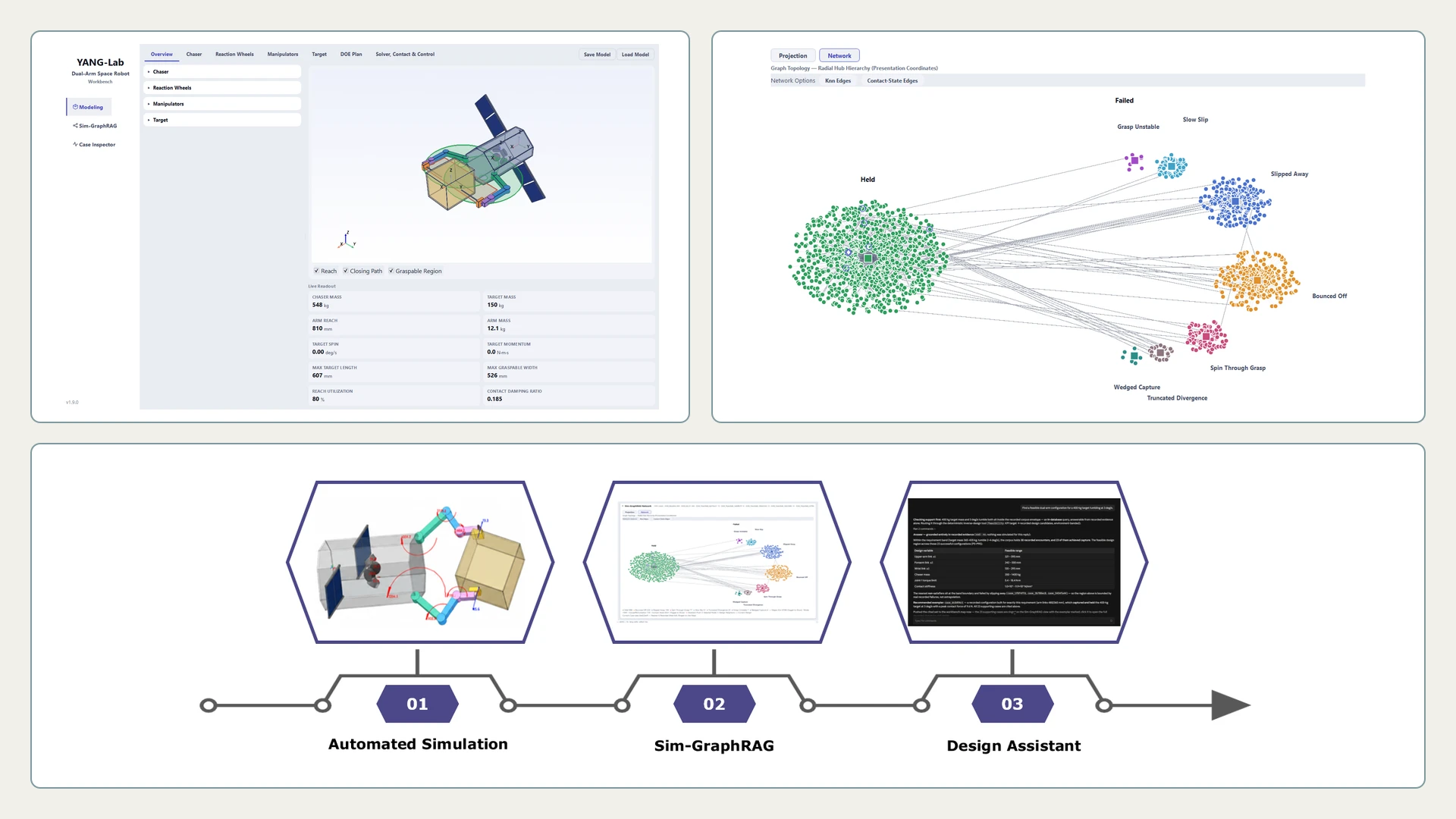
01 Capture Problem & Simulation Model
Capturing a tumbling target depends on both spacecraft design and initial capture conditions. The model represents a free-floating chaser whose two end-effectors approach the target along prescribed straight-line paths from opposite sides. Four reaction wheels regulate its attitude while base translation remains unactuated.
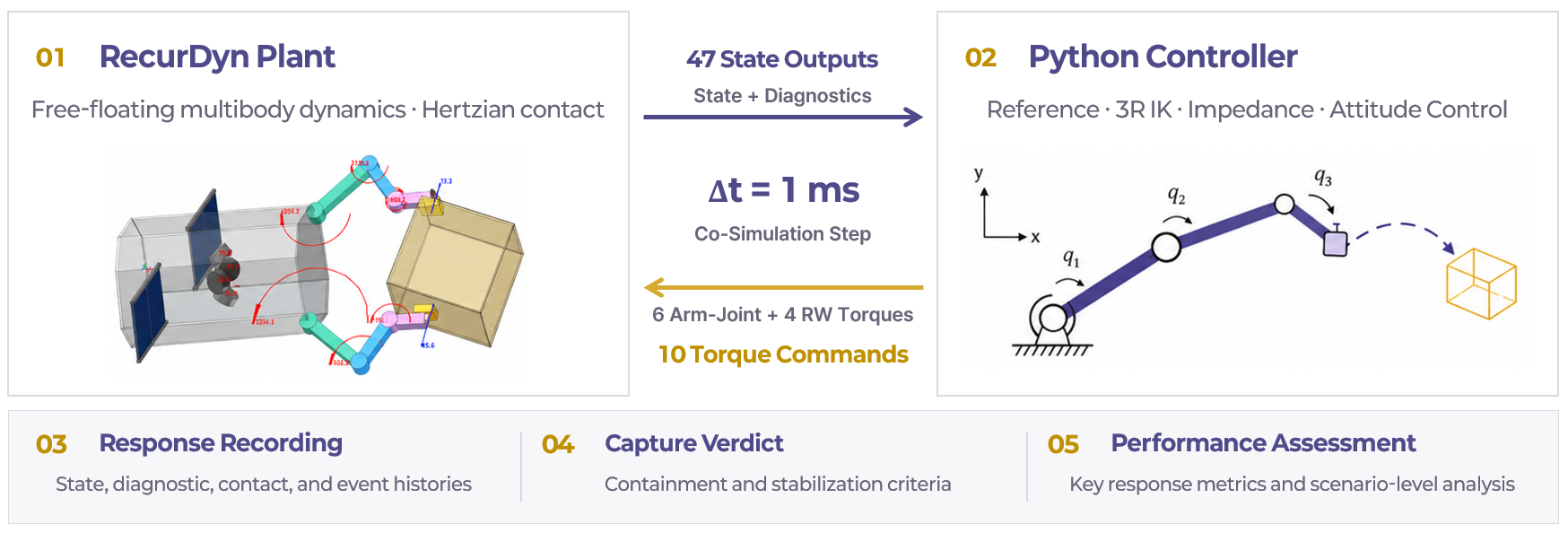
RecurDyn solves the coupled multibody and contact dynamics, while Python computes arm-joint and reaction-wheel control torques. The co-simulation records motion and contact histories to assess capture using containment and stabilization criteria.
02 Automated Model Generation & Simulation
A parametric workbench defines the spacecraft, arms and capture conditions. The workflow automatically generates a RecurDyn model, runs the co-simulation and records the results. Joint torques and contact forces can be inspected during simulation, followed by a replay of the capture sequence and its recorded events.
03 Sim-GraphRAG
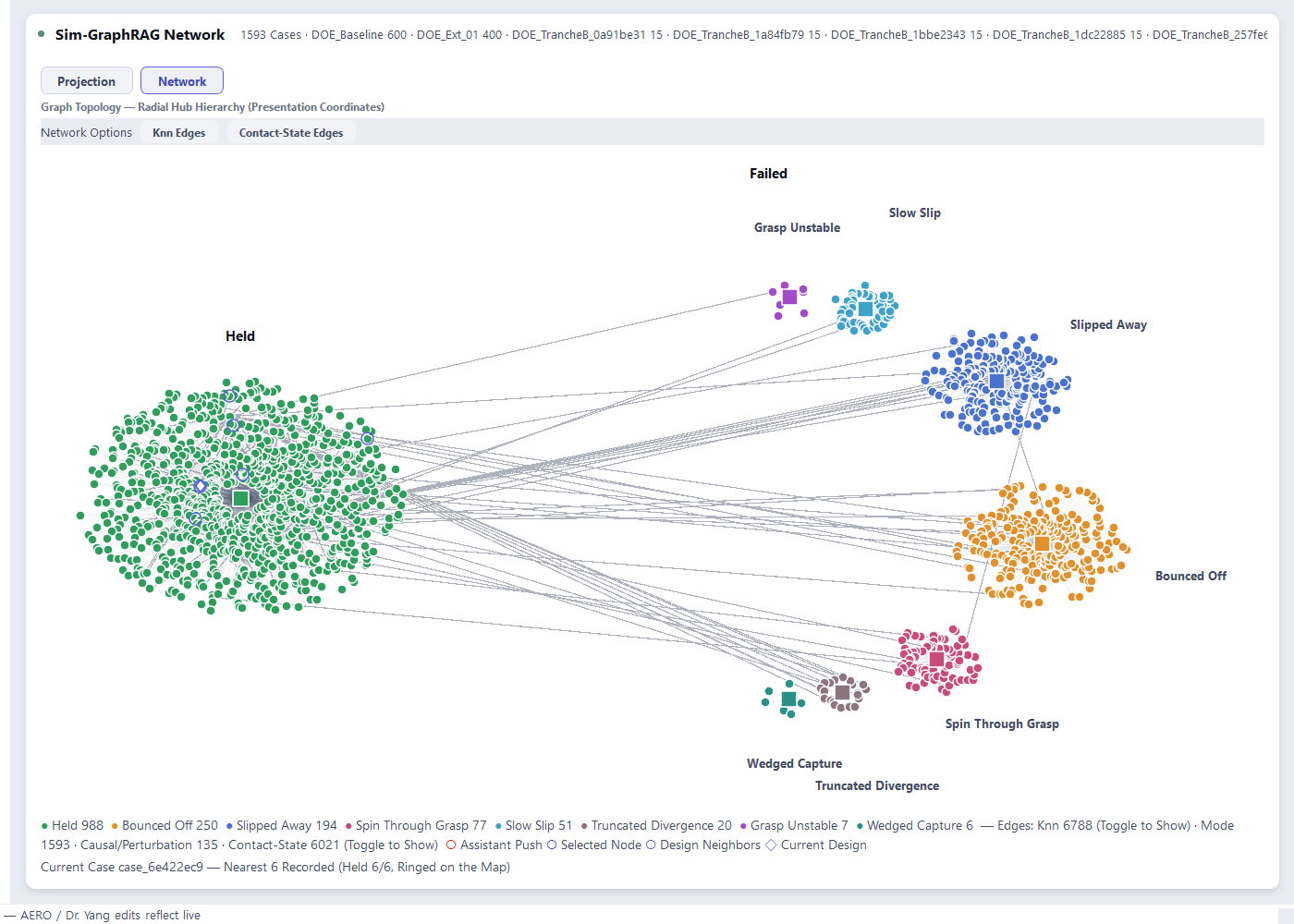
Sim-GraphRAG combines a simulation knowledge graph with retrieval-augmented generation, in which a large language model (LLM) develops an answer using retrieved evidence.
Each node represents a recorded simulation case, linking numerical inputs, responses and contact events to an interpretation of the outcome. Edges connect similar designs, comparable states at first contact, shared capture outcomes and controlled parameter comparisons. For a specified case, the graph retrieves related simulation records for comparison.
04 LLM-Assisted Design
Conversational queries support the search for recorded designs that meet specified target and capture requirements. Numerical tools screen feasibility and estimate outcomes; the LLM presents the results with supporting case references. The demonstrated workflow retrieves feasible recorded designs, inspects their capture histories and checks a proposed wrist geometry. It rejects an infeasible configuration, proposes an alternative and estimates its capture outcomes from recorded evidence.