A coupled simulation examines how spacecraft motion, robotic-arm control and contact forces interact during satellite capture and docking.
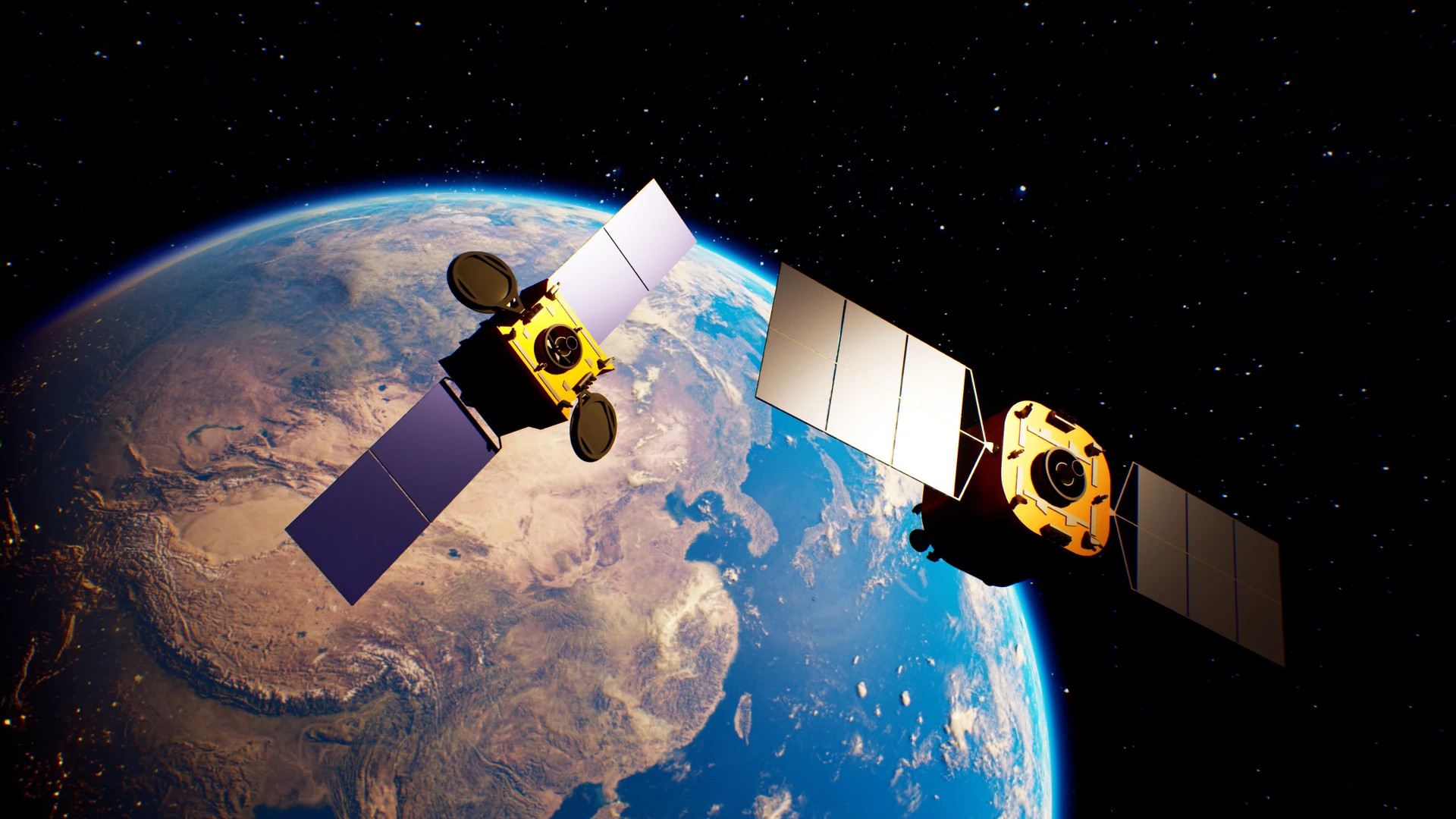
01 Satellite Models & Controller
The model pairs a 2,500 kg servicing satellite with a 2,000 kg target satellite. Three robotic arms on the servicing satellite grasp the target’s adapter ring. Both satellites are modeled as rigid bodies; their relative position and attitude are assumed known.
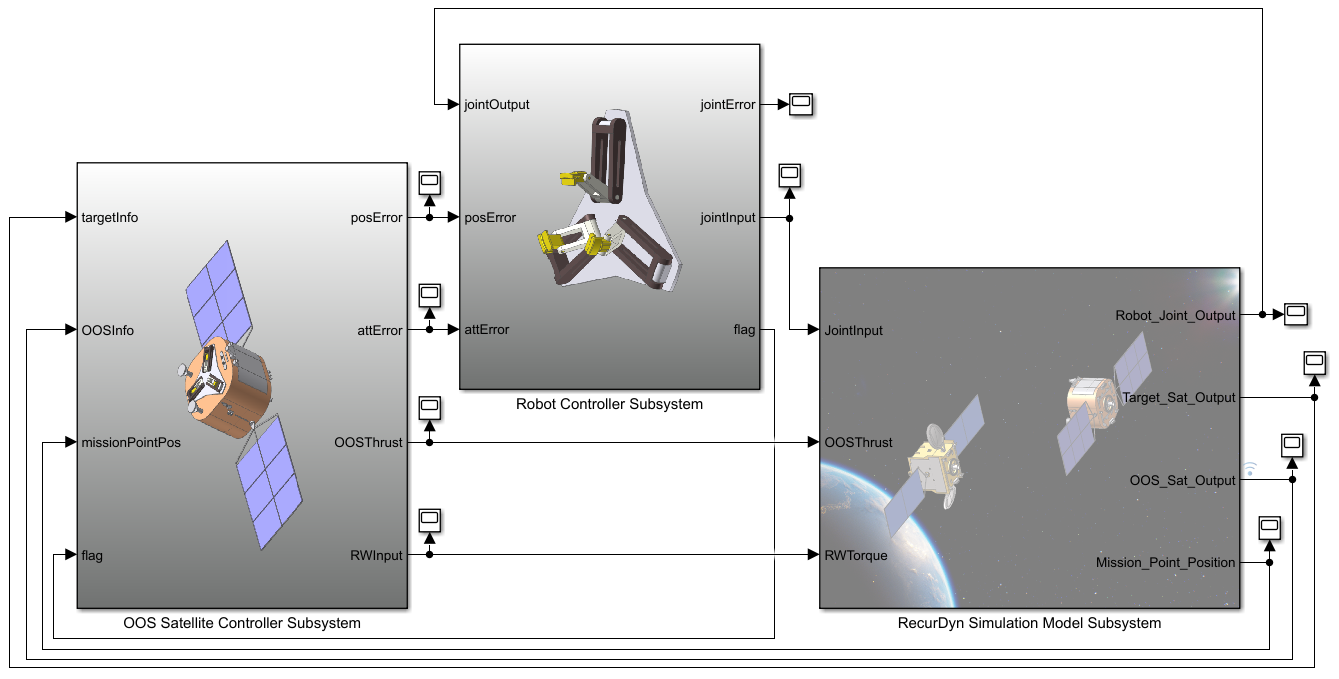
A proportional–derivative (PD) controller guides the servicing satellite to the docking position using thrust applied at its center of mass. A quaternion-error PD controller tracks the target’s attitude through four reaction wheels in a pyramid arrangement.
02 Robotic Arms & Controller
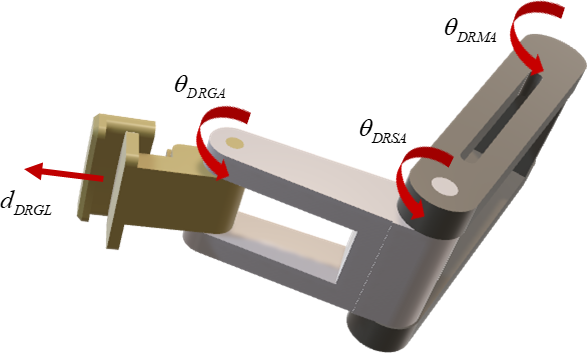
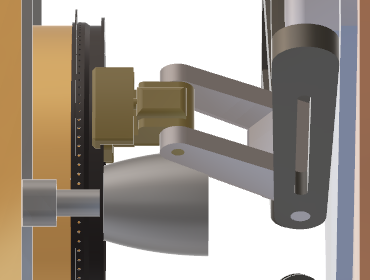
Each planar arm has three revolute joints and a sliding gripper. Inverse differential kinematics converts end-effector trajectories into joint commands tracked by proportional–integral–derivative (PID) controllers.
Once spacecraft position and attitude errors fall within the docking tolerances, the arms deploy toward the adapter ring. The grasping trajectory updates with the target’s current position and attitude, and the sliding grippers establish contact and grasping force. After capture, higher feedback gains guide pulling; the arms then hold their final joint positions during stabilization.
03 Docking Simulation
MATLAB/Simulink implements the spacecraft and arm controllers, while RecurDyn solves the coupled multibody motion and contact forces. The co-simulation follows the approach, grasping and pulling sequence through stabilization.
The analyses examine position and attitude tracking, reaction-wheel torque and arm joint loads, and how target rotation and arm force and torque limits affect grip retention.